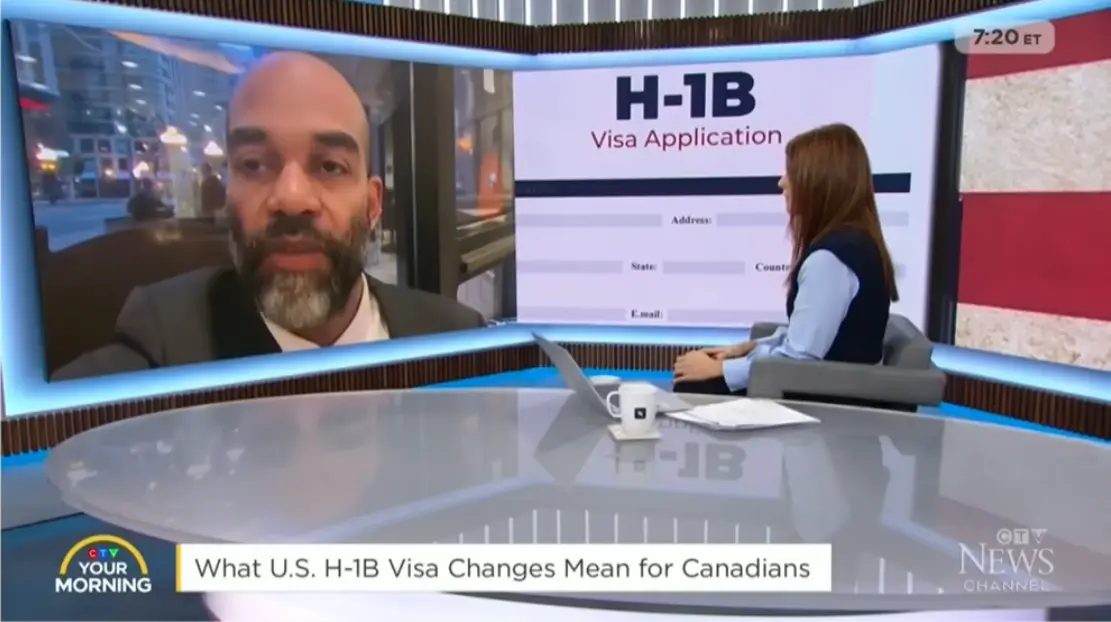
What Changed: The New $100,000 H-1B Fee
The H-1B visa allows U.S. companies to hire highly skilled foreign workers when qualified American workers cannot be found. Since the program launched in 1990, the fee for filing an H-1B petition ranged between $2,000 and $5,000.
That has now changed. As of a recent executive order, U.S. companies are required to pay a one-time fee of $100,000 per new H-1B application. The increase is dramatic, and it is already creating confusion and concern on both sides of the border.
Why Is This Happening Now?
Steven points to the broader geopolitical context as the likely driver:
“The H-1B visa is disproportionately used with nationals from India, who represent approximately 75%, and China is coming in second with approximately 12%. Which means that there are possible trade implications here as the United States enters negotiations and trade wars with various powers around the world, including India and China. This is possibly a negotiation tactic with relations to trade. It certainly is an interesting time for them to be implementing this, but it likely has something to do with the trade wars that are going on right now.”
The Administration’s Justification
The U.S. administration has described the H-1B program as “one of the most abused visa programs in the country.” Steven addressed the basis for that claim directly:
“The administration has presented a variety of data in the executive order saying that primarily IT companies are using the H-1B system to bring in lower-paid and lower-skilled workers, and that in turn is suppressing the employment of qualified U.S. citizens. They’ve cited data that suggests that some U.S. workers have been laid off and have been required to train their foreign national replacements, speaking on anonymity based on non-disclosure agreements. There are not a lot of citations as to where this data is coming from, but the H-1B has been contested ever since its creation.”
The picture is not one-sided. Steven noted that studies on the H-1B’s impact are mixed:
“There are a number of studies that suggest that it does have a negative impact on wages. There are other studies that say that it is a positive and an uplift. I think that we can say that they’re using data that supports the claim of suppressing wages for U.S. workers and eliminating jobs for U.S. workers as well.”
What This Means for Canadians Currently on H-1B Visas
Canadians hold approximately 1.1% of H-1B visas a relatively small share, but a meaningful number of individuals. The key question is whether existing holders are affected.
Steven’s answer is reassuring for those already in the system:
“They made an announcement clarifying that the implications would not redound to current visa holders, those who are renewing their H-1Bs, and those that are already in the system. So as far as Canadians who are currently on an H-1B, these changes should not impact that.”
That said, the situation remains fluid:
“When President Trump or any president issues executive orders, they are often met with legal challenges. It’s possible that there could be an injunction. When Trump issued a ban on H-1Bs in 2020, that was overturned by a federal judge. So these are still early days and it’s going to take some time to untangle what the implications are of this executive order. But as it stands at the moment, Canadians who are currently on H-1B visas are not expected to be affected.”
What About Canadian Employers Considering H-1B Workers?
For Canadian companies with U.S. operations, or U.S. companies looking to bring in Canadian talent via H-1B, the $100,000 fee changes the calculus significantly. At this cost, employers will be far more selective about which positions they choose to sponsor.
If your company is navigating cross-border staffing, or if you are a professional weighing your options between the U.S. and Canadian systems, our team can help you assess the alternatives. Canada’s work permit options, including LMIA-based permits and LMIA-exempt categories under CUSMA, may offer a more predictable path for skilled workers and their employers.
Questions About Your H-1B or Cross-Border Work Status?
The rules around H-1B are changing quickly, and what applies today may shift as legal challenges work through the courts. If you are a Canadian on an H-1B, an employer reconsidering your U.S. hiring strategy, or a professional exploring Canada as an alternative, our team of immigration lawyers in Toronto can help you understand your options.
Fill out our immigration questionnaire or call us at (416) 646-3523.